
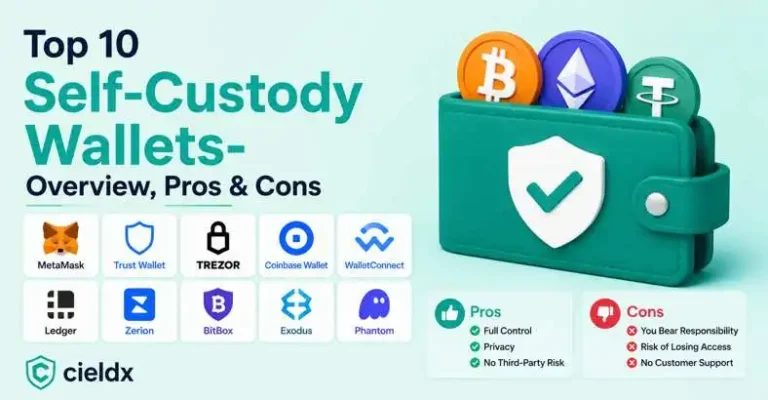
Just like cryptocurrency adoption is growing, so should be your steps towards ensuring security and control over digital assets. This leads to the growing interest of users in self-custody wallets. A self-custody wallet is something that allows you to store and manage your digital assets without depending on third-party custodians or centralized exchanges. Such wallets are known to give users complete ownership of their private keys so that they can completely manage their funds on their own.
Though these wallets give you the full responsibility to manage your assets, it comes with an added responsibility. However, it is known to significantly reduce the risk of account freezing, third-party failures, and exchange hacks. Through this guide, we’re going to give you deep insights into the top 10 self-custody wallets that you may consider during your crypto trading journey.
A quick comparison table for the wallets covered
| Wallet | Type | Best For | Key Strength |
| MetaMask | Software | Ethereum users | DeFi integration |
| Trust Wallet | Software | Beginners | Multi-chain support |
| Rabby Wallet | Software | Advanced traders | Security-focused transactions |
| Phantom | Software | Solana users | Seamless Solana experience |
| Coinbase Wallet | Software | New crypto users | User-friendly interface |
| Exodus | Software | Portfolio management | Beautiful design |
| Ledger Nano X | Hardware | Long-term investors | Industry-leading security |
| Ledger Flex | Hardware | Premium users | Enhanced usability |
| Trezor Safe 5 | Hardware | Security enthusiasts | Open-source ecosystem |
| Keystone | Hardware | Offline storage | Air-gapped protection |
Factors we considered for wallet rankings
In order to create this list, we have included several criteria that eventually helped us with the same:
- Security features
- Private key protection
- Asset and blockchain support
- User experience
- Ease of use
- Backup and recovery options
- Community reputation
- Trustworthiness
- Hardware wallet integration
- Development and updates
Top 10 wallets- Explanation, features, pros & cons
-
MetaMask
This wallet stays as one of the most widely used self-custody wallets that we have today and is quite popular in the crypto trading industry. Currently, MetaMask supports Ethereum and EVM-compatible networks.
| Features | Pros | Cons |
|
|
|
-
Trust Wallet
It offers a beginner-friendly experience and supports a wide range of digital assets on multiple blockchains. This turns out to be a great option for anyone who wishes to trade in multiple assets.
| Features | Pros | Cons |
|
|
|
-
Rabby wallet
The wallet has grabbed the undivided attention of advanced crypto traders due to its high-tech security mechanism. Besides, it is also widely popular for transaction simulation.
| Features | Pros | Cons |
|
|
|
-
Phantom wallet
If you are someone who trades on the Solana ecosystem, this wallet is just for you. Here are some key features, pros, and cons to consider before using it:
| Features | Pros | Cons |
|
|
|
-
Coinbase wallet
The Coinbase wallet works completely different from that of the Coinbase exchange. This is a non-custodial wallet that allows users to control their private keys completely.
| Features | Pros | Cons |
|
|
|
-
Exodus wallet
Exodus is known for its ease-of-use and has a wide range of portfolio management features. If you are planning to trade a wide range of assets, this wallet could be the best choice for you.
| Features | Pros | Cons |
|
|
|
-
Ledger Nano X
When it comes to crypto wallets, Ledger Nano X is one of the most widely used crypto wallets out there. The reason why it has gained traction among users is that it is a hardware wallet that keeps your crypto assets offline, away from potential hacks and scams.
| Features | Pros | Cons |
|
|
|
-
Ledger Flex
The wallet offers a more modern user experience while ensuring that you get to enjoy the offline storage feature and the strong security framework offered by Ledger.
| Features | Pros | Cons |
|
|
|
-
Trezor safe 5
Trezor has a long standing reputation when it comes to a self-custody wallet. It turns out that most security features that you may find in other versions of the suite are available in this wallet model.
| Features | Pros | Cons |
|
|
|
-
Keystone
This wallet has been designed around an air-gapped security model that reduces the risks that may be caused by online attack surfaces.
| Features | Pros | Cons |
|
|
|
Use CieldX Wallet- A new, yet feature-rich wallet
Download the CieldX Wallet app to securely store, manage, and grow your digital assets. CieldX is a non-custodial wallet that brings multiple wallet features into one platform, so you don’t need several apps. It supports 15,000+ cryptocurrencies, NFTs, and multiple blockchain networks.
The wallet prioritizes security and privacy while giving you complete control of your assets. Key features include:
- Manage and diversify your portfolio in one place.
- 24/7 threat monitoring and security alerts.
- Securely store assets across multiple blockchain networks.
- Instantly swap crypto with one tap.
- Fast internal wallet transfers with no delays.
- Recover access with Smart Seed Phrase Recovery.
- Manage multiple wallets from a single dashboard.
Self-custody wallet security tips
Choosing a suitable self-custody wallet among many options can be a daunting task. However, at the same time, you need to follow best security practices:
- Make sure you protect the seed phrase by all means
- If your wallet allows, enable additional security layers
- Stay alert for phishing attacks
- Make sure that you verify the wallet website before installing
- Keep your wallet software updated
Conclusion:
Self-custody wallets give users complete ownership of their crypto assets while minimizing their dependency on centralized platforms. If you prefer using a software wallet, you may go ahead with MetaMask or Trust wallet. On the other hand, if hardware wallets amaze you, you can choose any version of the Ledger or Trezor wallet. The choice is yours.